
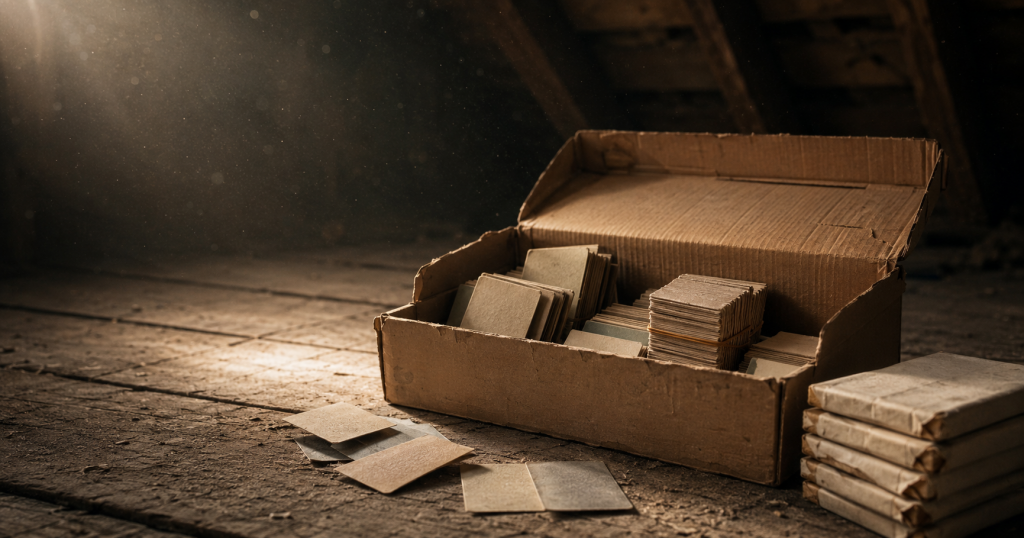
It happens more than you would think. Somebody cleans out a parent’s house, opens a closet, and there it is. A shoebox, a couple of binders, maybe a stack of factory sets still in shrink wrap. Nobody in the family collects. Nobody knows if any of it is worth anything. And nobody wants to be the one who threw away something good.
Here is how to think it through before you do anything else.
First, leave it alone
The instinct is to clean it up and organize it. Resist both. Do not wipe cards down, do not use any kind of cleaner, and do not peel old tape off anything. Surface damage is permanent, and it is the fastest way to turn a good card into an average one.
If a stack is held together with rubber bands, cut the bands instead of sliding them off. The edges underneath are already dented and pulling makes it worse.
Do not toss the packaging either. Old boxes, wrappers, and unopened packs can matter on their own.
Second, find out when the collection was built
Look at the years printed on the cards. That tells you more than any player name will.
If most of it lands between 1987 and 1994, you have found what the hobby calls the junk wax era. Manufacturers printed enormous quantities in those years and the supply never went anywhere. Complete sets and commons from that stretch usually carry very little value no matter how sharp they look. That is not a knock on whoever built the collection, it is just the math of how many were made.
If the cards are from before 1980, slow down. Older cardboard is where the surprises live, and condition swings the value hard. A 1970s star card with clean corners is a completely different conversation than the same card with soft ones.
Anything from the last decade comes down to which specific cards are in there. Autographs, serial numbered cards, and rookies of players who actually panned out carry the weight.
Third, pull the interesting stuff aside
You do not need to appraise anything yourself. You just need to separate the maybe from the probably not. Set aside anything unopened, anything signed, anything numbered like 15/99, and any card of a name you would recognize from a Hall of Fame ballot.
Our buying page has the full list of what to flag and how to put together a quick inventory before you come in. Ten minutes with that list ahead of time makes the whole visit faster.
Fourth, get eyes on it
This is the step people put off, usually because they are worried about being taken. Fair concern.
Here is how it works at the Lab. You sit down with someone who goes through it with you, tells you what you have and what you do not, and gives you a straight read either way. No charge for the look, and no pressure to sell at the end of it.
If we make an offer and you take it, we work out payment in whatever form fits the deal, check, Venmo, Cash App, or PayPal. Store credit is an option too, if you would rather turn a relative’s collection into something you actually want on your own shelf.
Walk in any time Tuesday through Saturday. If you are sitting on something big, a full closet, an estate, more boxes than you can carry in one trip, call ahead at 276-608-1607 so we can block out real time for it.
One last thing. If you are reading this as the collector rather than the person cleaning out the house, go read our post on estate planning for card collections. The best time to sort this out is while you are still here to explain what everything is.